兰戈
GT Voice: Chinese investment could help Germany stabilize its talent base_我的网站

一 | 中新社呼和浩特8月22日电 (记者 刘文华)2026绿色算力(人工智能)大会22日在内蒙古自治区呼和浩特市举行,院士专家、产业链企业代表等500余人参会,大会集中签约13个项目,签约项目总投资额1361亿元(人民币)。 内蒙古是全国一体化算力网络国家枢纽节点。

二 |
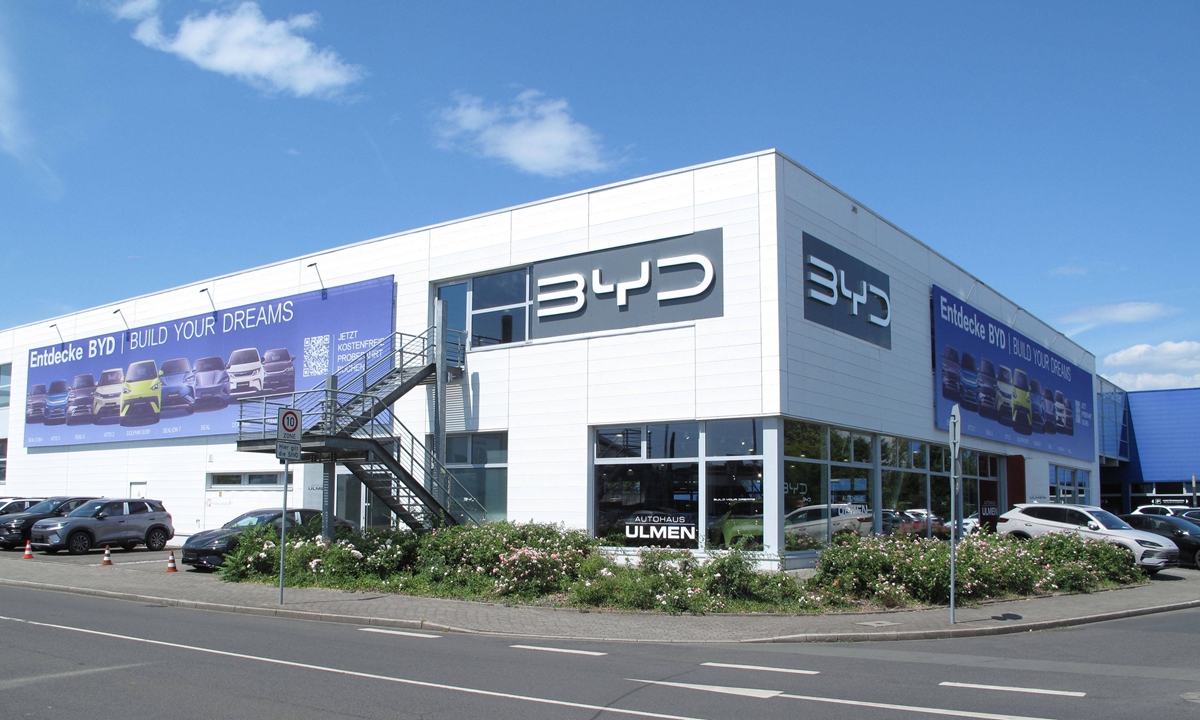
A BYD flagship store at the Ulmen car dealership on H?herweg Auto Mile in Düsseldorf, Germany, with new cars on display out front. Photo: VCG
Germany's industrial woes have increasingly become a hot topic of discussion. The latest Engineer Monitor report from professional association Verein Deutscher Ingenieure and the German Economic Institute offers a new look at the issue.
The report showed that there were 58,392 unemployed individuals in the engineering and information technology (IT) professions in the fourth quarter of 2025, the highest level since the survey began in 2011.
Compared with the previous year, the number of unemployed increased by 16.7 percent, according to German media reports on Sunday.
These figures lay bare the challenges confronting the country's manufacturing sector. The reasons for the industrial woes are multiple. The soaring energy costs caused by geopolitical conflicts, the decline in exports caused by rising protectionism and low external demand, and the structural pain caused by industrial chain restructuring are all squeezing the space of German manufacturing.
Manufacturing is the backbone of Germany's economy, and engineers and IT specialists constitute the core force that sustains this pillar. For decades, the country's reputation for "Made in Germany" excellence was built on the expertise of these skilled professionals. Regardless of the macroeconomic ups and downs, preserving the stability and continuity of its industrial talent pool represents a strategic bottom line for Germany.
Should large numbers of highly skilled technical professionals leave the industry or sit idle, industrial research and development (R&D) and production cycles will be disrupted. Over the longer term, such a waste of human capital will erode Germany's industrial innovation capacity and, ultimately, undermine the foundations of its global competitiveness.
In this context, the urgent task for Germany is to create sufficient quality positions for its technical talent. Should it fail to do so in the short term, then Germany needs to embrace a more open‑minded development approach. Shoring up its manufacturing base cannot be achieved solely through protecting domestic companies; it also requires a significant expansion of effective investment to create enough high‑quality jobs that can attract and retain skilled talent.
This is exactly where China‑Germany cooperation could deliver tangible results. According to the FDI Report 2025 published by Germany Trade & Invest (GTAI), the total number of foreign investment projects in Germany fell 9.3 percent overall to 1,564 in 2025. Nonetheless, Chinese companies became the largest source of foreign investment projects in Germany in 2025, overtaking the US for the first time since 2017.
Chinese companies launched 228 investment projects in Germany in 2025, up 14.6 percent year-on-year. More than one in five Chinese investment projects involved production and R&D activities, above the overall average for foreign investment projects in Germany. This is a sign that Chinese firms are deepening their integration into the local industrial base, according to GTAI.
Observers noted the trend, pointing out that China is becoming an important force in driving German re‑industrialization. In industries where Germany urgently needs to rebuild its competitive edge, such as electric vehicles, batteries, energy technology, digital manufacturing, and automation, China is emerging as an increasingly significant complementary partner. In these critical areas that will determine industrial competitiveness in the coming decades, the relationship between China and Germany is not merely one of rivalry; there are clear and substantial complementarities. Germany still boasts world‑leading engineering expertise, precision manufacturing capabilities, and a strategic location at the heart of the European market.
China has complete and highly integrated supply chains for raw materials and intermediate goods and large capacity for increasing production. When Chinese automakers set up R&D centers in Germany, or when Chinese tech firms collaborate with German factories to build smart production lines, the beneficiaries are not only the Chinese companies but also the German engineers who would otherwise face redundancy.
Cross‑border investment cannot flourish without a sound policy environment. Chinese companies are apparently willing to develop in Germany, but it can only happen on the premise that the German side provides a fair, reasonable and predictable business environment, reduces non-market interference in commercial activities, and allows capital to operate in accordance with market rules.
If the two countries are able to reach a deeper level of cooperation in investment, many of Germany's trade‑related concerns may well find more pragmatic solutions. The deep integration of industrial value chains would facilitate two‑way trade, creating renewed momentum for German exports of machinery, vehicles, chemicals, and other competitive products to China.
。

三 | 本次签约的13个项目分落呼和浩特、乌兰察布两地,其中呼和浩特签约8个项目,包括火山引擎GW级园区、寒武纪芯片实验室、海悟算力装备产业园等;乌兰察布签约5个项目,包括火山引擎GW级算力中心、协鑫能科算电协同一体化项目、中国电信数据中心等。 区别于传统数据中心单纯扩容模式,本次签约的项目实现算力产业链全链条延伸,覆盖上中下游关键环节:上游补齐芯片检测、算力装备制造硬件短板;中游夯实算力中心、算电协同核心配套;下游布局词元交易、人工智能场景应用。这也标志着内蒙古算力产业正式告别单一“机房+电力”的基础服务模式,向完整、闭环的算力全产业链升级。 本届大会还发布了《绿色算力发展研究报告(2026 年)》《“东数西算” 枢纽节点绿色算力指数研究报告(2026 年)》等权威研究成果,集中亮相国家首批可信数据空间、城域 “毫秒用算”、人工智能应用场景、绿电基础设施等一批试点建设成果,启动数字服务出海综合服务平台,全国视频大模型算力基地正式落成。

四 |
Current article:http://6u5qvp4.kenouguanruilianshanxiangshu.cfd/list_i9t/aw3s.html
Published on:17:13:21


